PIPEDA Safeguards for Private Clinics in Canada: A Practical Checklist
PIPEDA safeguards are the security measures Canada's federal privacy law expects organisations to put around personal information, and for private clinics that means protecting patient records, photos, payment details and messages. The Personal Information Protection and Electronic Documents Act does not list specific technologies. Instead, its safeguards principle asks for protection that matches how sensitive the information is, and health information is generally treated as sensitive. That leaves each clinic to decide what reasonable protection looks like in practice.
This guide turns the Office of the Privacy Commissioner of Canada's guidance into a practical checklist for private clinics, using the OPC's summary of PIPEDA requirements and its page on the safeguards principle, read on 29 November 2026. Provincial laws may apply instead of or alongside PIPEDA, so confirm which law covers your clinic. It is general information and not legal advice.
Key takeaways
- The OPC says PIPEDA applies to private-sector organisations that collect, use or disclose personal information in commercial activity, with substantially similar laws in some provinces.
- The OPC lists Ontario, New Brunswick, Nova Scotia and Newfoundland and Labrador as having substantially similar health information laws, and says information crossing provincial or national borders remains subject to PIPEDA.
- The OPC's safeguards principle says protection must match the sensitivity of the information, and health information is generally considered sensitive.
- Safeguards should be physical, technological and organisational, and reviewed regularly, according to the OPC.
- PIPEDA does not prescribe specific measures, so document what your clinic does and why.
Which law applies to your clinic
The OPC's summary of PIPEDA requirements says the law applies to private-sector organisations that collect, use or disclose personal information in the course of commercial activity. It says Alberta, British Columbia and Quebec have private-sector privacy laws considered substantially similar, and that Ontario, New Brunswick, Nova Scotia and Newfoundland and Labrador have substantially similar laws for health information. It also says personal information that crosses provincial or national borders remains subject to PIPEDA. A clinic in Ontario may therefore be governed mainly by PHIPA for health records, while still being subject to PIPEDA for some activities. The guide to PHIPA for Ontario clinics explains Ontario's rules.
PIPEDA safeguards: what the principle asks for
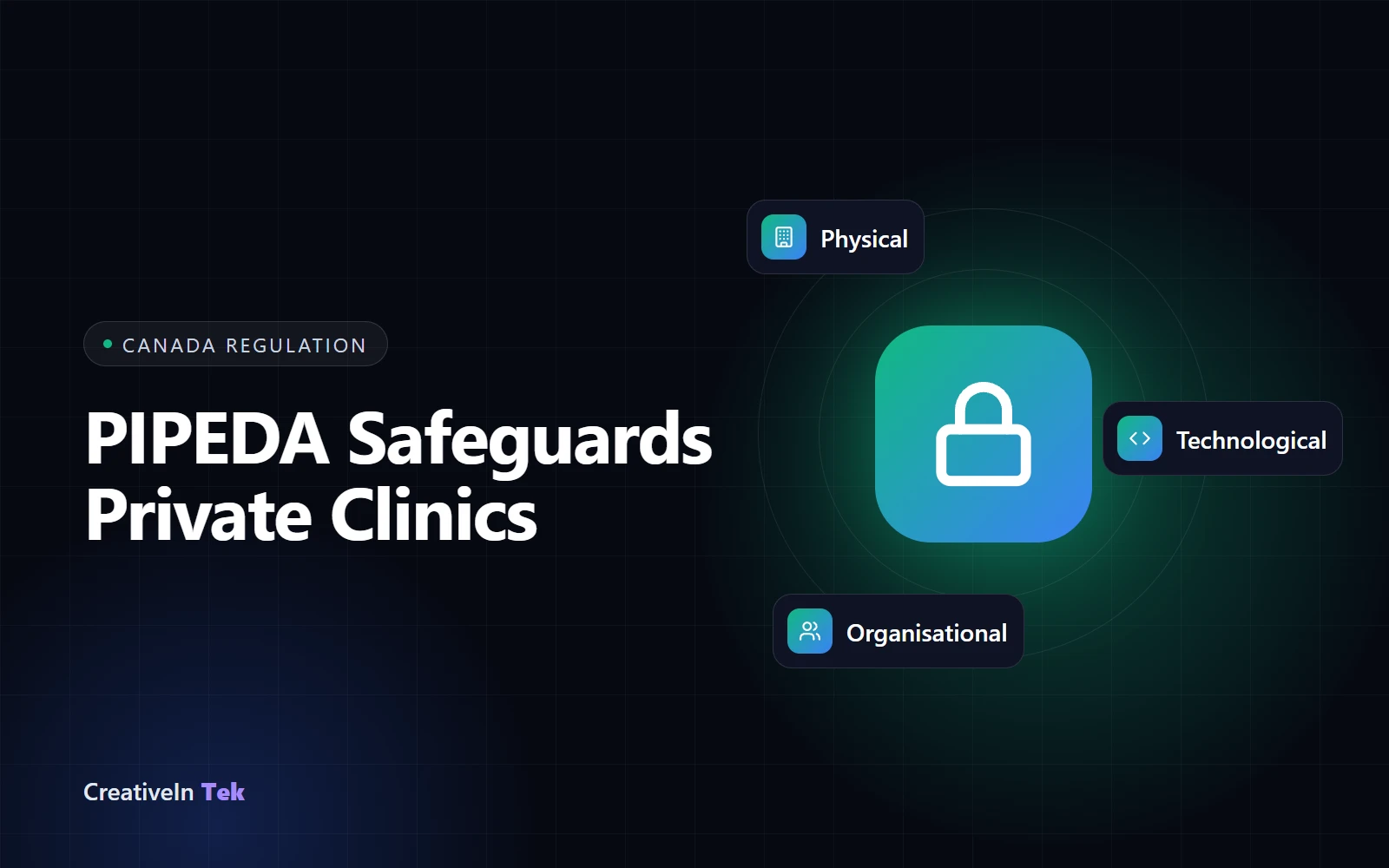
The OPC's page on fair information principle 7, safeguards, says protection should match how sensitive the information is and that health information is generally considered sensitive. It describes three kinds of safeguards: physical measures such as locked filing cabinets and restricted access to offices, technological measures such as passwords, encryption, firewalls and software patches, and organisational measures such as limiting access on a need-to-know basis, staff training and confidentiality agreements. It says safeguards should be reviewed regularly and that PIPEDA does not prescribe specific measures.
The checklist for private clinics
Physical safeguards
- Keep paper records in locked cabinets and limit who has keys.
- Position reception screens so patients cannot read them.
- Lock devices and offices when unattended.
- Shred paper records when they are no longer needed.
Technological safeguards
- Give every staff member their own login, never shared passwords.
- Use software with role-based access, so each person sees only what they need.
- Turn on encryption for devices and backups.
- Keep systems and devices patched and updated.
- Keep patient photos in the clinic system, not on personal phones.
- Back up data regularly and test restoring it.
Organisational safeguards
- Name a person responsible for privacy.
- Train staff at induction and at least yearly.
- Use confidentiality agreements with staff and suppliers.
- Remove access promptly when staff leave.
- Write a simple breach response plan.
- Review safeguards at least once a year.
Choosing software with safeguards in mind
When choosing clinic software, ask vendors about access controls, audit logs, encryption, backups, where data is stored and how data can be exported or deleted. The guide to skin clinic software in Canada covers features and prices, and the guide to health data residency in Canada covers where data may be stored.
Common gaps in small clinics
- Shared logins at reception.
- Patient photos on staff phones.
- Former staff still able to log in.
- No tested backups.
- No record of what safeguards are in place.
Documenting what the clinic does
Because PIPEDA does not prescribe specific measures, a clinic should be able to explain what it does and why. A short written record is enough for most small clinics: who is responsible for privacy, which systems hold personal information, who has access to each, how devices and backups are protected, how staff are trained, and how the clinic would respond to a breach. Review the record each year, after staff changes and after any incident. If the clinic changes software or adds a new tool such as online booking or an AI assistant, update the record before going live. Keeping this simple document current also makes it easier to answer patient questions about how their information is protected and to respond if a regulator ever asks.
It also helps to think about suppliers. Every company that stores or processes patient information on the clinic's behalf, such as a software vendor, an IT contractor or a backup service, should have an agreement that covers confidentiality and security, and the clinic should know where each supplier stores data.
Where CreativeIn Tek fits
CreativeIn Tek's CareTrack is clinic management software with individual staff logins, role-based access, patient records and backups that can support a clinic's safeguards. It does not claim Canadian data hosting and does not make a clinic compliant with PIPEDA or provincial laws; safeguards and policies remain the clinic's responsibility. A Canadian clinic can talk to CreativeIn Tek about how access and records are set up.
Frequently asked questions
Does PIPEDA apply to private clinics?
The OPC says PIPEDA applies to private-sector commercial activity unless a substantially similar provincial law applies, and some provinces have their own health information laws.
What are PIPEDA safeguards?
Physical, technological and organisational measures that protect personal information, matched to its sensitivity, according to the OPC.
Does PIPEDA require encryption?
The OPC lists encryption as an example of a technological safeguard but says PIPEDA does not prescribe specific measures.
How often should safeguards be reviewed?
The OPC says regularly. Many clinics review at least once a year and after any incident.
Is health information sensitive under PIPEDA?
The OPC says health information is generally considered sensitive, so it needs a higher level of protection.
Last reviewed: 29 November 2026, against the OPC's PIPEDA requirements in brief and its page on the safeguards principle. This article is general information and not legal advice.